
Golf strength
Strength training for golfers: build force without losing your swing
You do not need a gym full of swing imitations. Two well-built full-body sessions can strengthen the legs, hips, trunk, back, and arms that produce and manage force in golf.
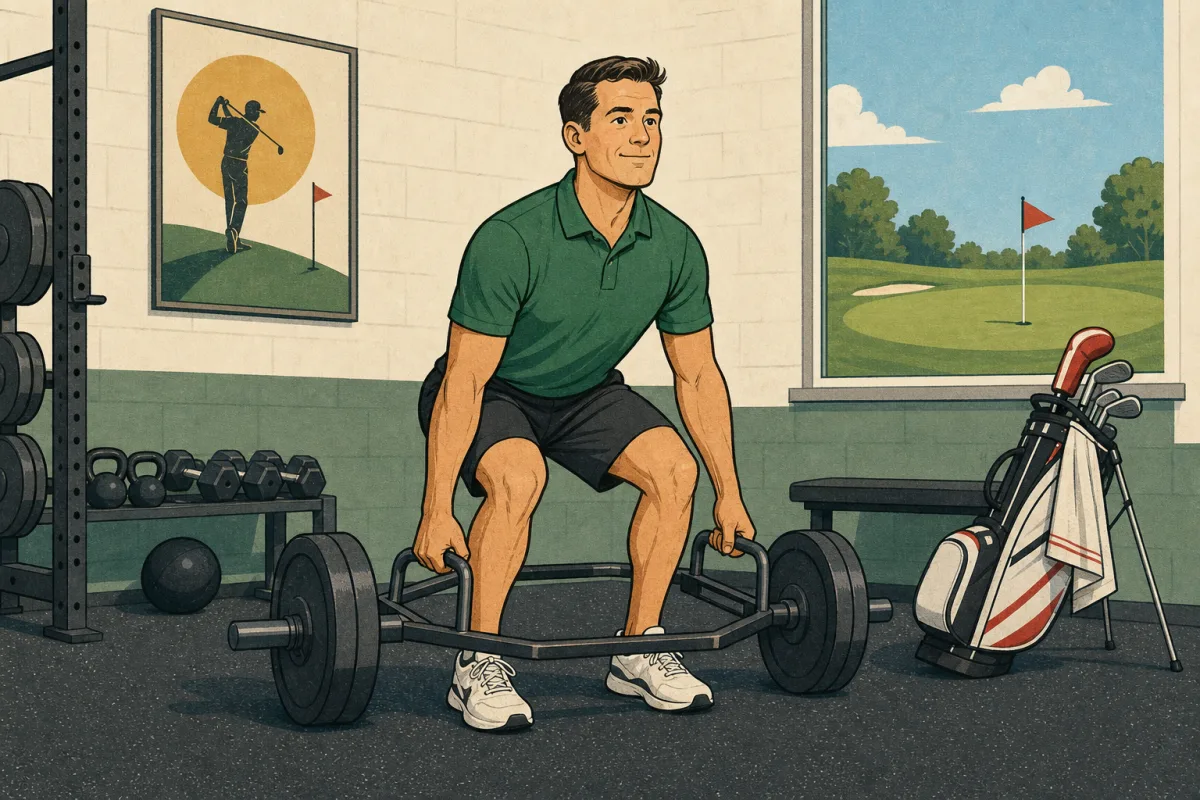
Why lift weights for golf?
Strength creates options. It can support force into the ground, help you maintain posture, and give you more reserve for practice and long rounds. Research reviews generally find that resistance programs improve clubhead speed or driving distance, especially when traditional strength work is paired with low-volume, high-speed movement.
The gym does not replace instruction. Swing speed still depends on technique, sequencing, confidence, and the ability to express force quickly. Think of strength as increasing the size of the engine while practice teaches you to use it.
The movement menu
- Squat or lunge: goblet squat, split squat, or step-up.
- Hinge: kettlebell deadlift, trap-bar deadlift, or Romanian deadlift.
- Push and pull: push-ups, dumbbell presses, rows, and pulldowns.
- Carry: farmer or suitcase carries for grip, trunk, and walking posture.
- Trunk control: dead bugs and Pallof presses that resist unwanted movement.
- Power: a small amount of jumping or medicine-ball throwing once the basics feel solid.
Two-day beginner golf workout
Train on nonconsecutive days and take at least 48 hours between sessions. Warm up for five to ten minutes, then use loads that leave about one to three good repetitions in reserve.
Day A
- Goblet squat: 3 sets of 6-8
- One-arm dumbbell or cable row: 3 sets of 8-10 per side
- Romanian deadlift: 3 sets of 6-8
- Split squat: 2 sets of 8 per side
- Pallof press: 2 sets of 8-12 per side
- Suitcase carry: 3 walks of 20-30 meters per side
Day B
- Trap-bar or kettlebell deadlift: 3 sets of 4-6
- Dumbbell bench press or push-up: 3 sets of 6-10
- Lat pulldown: 3 sets of 8-10
- Step-up: 2 sets of 8 per side
- Dead bug: 2 sets of 6-10 per side
- Farmer carry: 3 walks of 20-30 meters
These are templates, not commandments. Machines are valid substitutes. If an exercise is painful, technically uncomfortable, or unavailable, choose another movement from the same category.
Add power after building the base
After several weeks of consistent training, place power work near the beginning of a session, after warming up and before heavy lifting. Stop while every repetition is still quick and crisp.
- Medicine-ball rotational scoop toss: 3 sets of 4-6 per side.
- Small vertical or broad jump: 3 sets of 3-5.
You are training speed, not fatigue. More repetitions are not better when the throws and jumps slow down.
How to progress
Begin at the low end of each repetition range. When you complete every set at the top of the range with sound technique and a few reps left, add the smallest available amount of weight next time. A training log makes this pleasantly boring and effective.
Avoid a hard new session immediately before an important round. Many golfers do well lifting early in the week and keeping the day before competition light. Normal training can continue in season, but reduce volume when golf volume rises.
What to skip
- High-repetition loaded twisting performed into fatigue.
- Heavy golf-club swings that alter timing or stress the joints.
- Testing maximum lifts before learning the movement.
- Chasing soreness as proof that the workout worked.
- Ignoring pain because an exercise is described as golf-specific.
The golf swing already provides fast, repeated rotation. The weight room is a good place to build force and control without turning every drill into another maximal swing.
Pair this plan with the golf mobility routine and the 10-minute pre-round warm-up.